A conceptual framework is the study-specific explanation of the concepts or variables you will investigate and how they fit together. Start with a defined research problem and question, use scholarly literature to choose the concepts that matter, explain the expected relationship or organizing logic, and then create a visual only after the narrative is clear. The framework should align with your research questions, data collection, and analysis—not merely look polished.
What Is a Conceptual Framework in Research?
A conceptual framework explains the researcher’s understanding of the key concepts, variables, and relationships relevant to a particular problem. It can be written, visual, or both. National University’s doctoral guidance emphasizes that it should give a study direction, clarify concepts, and connect the problem statement, research questions, and methodology. [1]
That definition matters because a framework is not a decorative box-and-arrow diagram. It is a reasoned model that tells readers what your study is about, what you expect to investigate, and why your design is appropriate. A literature review helps you find the concepts; your framework selects and organizes the ones that answer your question.
Problem
What needs to be understood, explained, or explored?
Framework
Which concepts or variables organize the study?
Method
What evidence will answer the research question?
Before You Draw Anything: Choose the Right Kind of Framework
One common source of confusion is assuming every framework has the same job. A theoretical framework begins with an established theory that explains a phenomenon. A conceptual framework can begin with concepts from observation, prior evidence, and the logic of a particular study; it clarifies concepts and proposes relationships or context. [2]
| If your study asks… | Your framework may emphasize… | Avoid… |
|---|---|---|
| Which factors are associated with an outcome? | Defined variables and carefully justified expected associations | Calling an association causal without a design that supports it |
| How or why does a relationship occur? | A possible mechanism, such as a mediator, supported by literature | Adding a mediator because it makes the diagram look advanced |
| How do people experience or interpret a phenomenon? | Context, sensitizing concepts, and an interpretive lens | Directional arrows that imply tested causality in a qualitative design |
For a deeper side-by-side explanation, read Conceptual Framework vs. Theoretical Framework. The distinction is important: the two can complement each other, but using the labels interchangeably makes a methodology chapter less precise.
How to Write a Conceptual Framework: 7 Steps
Use this workflow before opening a diagram tool. It is designed to surface the reasoning that competitors often skip when they jump straight to templates.
Turn the topic into a research problem
A topic such as “social media and students” is too broad for a framework. State the specific problem your study addresses, the population or setting, and the outcome you want to understand. This keeps the model connected to a real research need instead of becoming a generic diagram.
Write one answerable research question
Your framework should answer a question, not merely decorate a chapter. For example: “How do study-planning habits relate to first-year students’ course performance?” The question tells you which concepts need a place in the framework.
Mine the literature review for repeated concepts
Use peer-reviewed research to identify definitions, measures, findings, tensions, and plausible explanations. A literature review should lead to the framework; it is not a separate task to complete after the diagram is drawn.
Name and define only the concepts you will study
For quantitative work, identify your outcome and plausible predictors. For qualitative work, identify sensitizing concepts, context, or processes that help organize inquiry. Define every item in a way a reader could recognize in your method and analysis.
State the proposed relationship or organizing logic
Explain why each connection belongs in the study. In quantitative work, this may be an expected association or hypothesis. In qualitative work, it may be a non-causal organizing relationship, context, or sequence. Do not draw a stronger claim than your design can support.
Draft the narrative before finalizing the visual
Write a short explanation of the framework in complete sentences. If you cannot explain what each box, arrow, category, or boundary means, the visual is not ready. The written narrative also makes citation and methodological alignment easier to audit.
Check alignment from problem to method
Read the chain in order: problem statement → framework → research questions → data collection → analysis. A strong framework makes each next choice more coherent. If an element does not affect a question or method, remove or justify it.
Start With Literature, Not a Blank Diagram
Use the Literature Review Generator to map the scholarly conversation, then turn the most relevant concepts into a study-specific framework.
Quantitative Conceptual Framework Example: Study Planning and Course Performance
Suppose your research question is: “How do study-planning habits relate to first-year students’ course performance?” A framework should not simply list “study habits” and “grades.” It should identify what is measured and why the proposed relationships are plausible.
Worked model (illustrative—validate it against your literature and supervisor guidance)
Predictor
Possible mediator
Outcome
The narrative would explain how prior research led you to study planning, why self-efficacy may help explain the relationship, how performance will be measured, and what other factors you will account for. It would not claim the relationship is proven before you collect data.
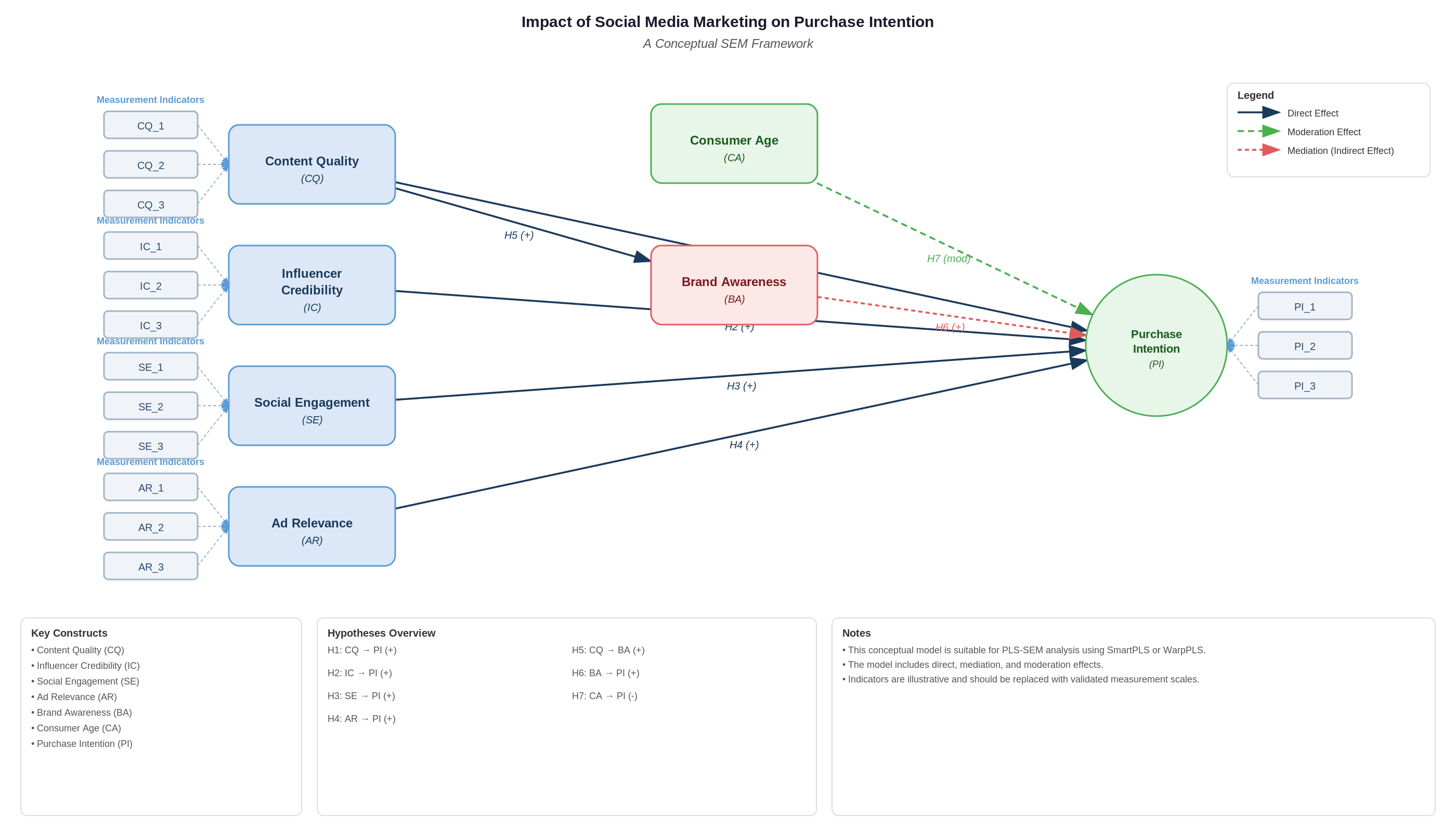
For a thesis project, connect this model to a clear thesis statement, research questions, and citations in the style your department requires. Use the Citation Generator to format sources, then verify the final reference list against your institution’s style guide.
Qualitative Conceptual Framework Example: Student Experiences of Online Learning
A qualitative framework can organize how you approach a topic without pretending you will test causal paths. For a study asking, “How do first-year students describe their experience of belonging in online courses?”, the framework may situate the inquiry around concepts such as interaction, access, belonging, and institutional context.
Qualitative design caution
National University advises that qualitative frameworks should not include arrows that imply causal or correlational links. Use categories, context, a narrative explanation, or a non-causal visual arrangement unless your methodology actually tests those relationships. [1]
This is an important keyword gap: many generic “framework examples” pages show arrows by default. A good qualitative framework is not a weakened quantitative model—it is an explicit statement of the lens and concepts that guide inquiry.
Variable Decision Table: What Role Does Each Item Play?
Use the table below as a questioning tool, not a labeling exercise. The role of a variable depends on the research question, logic, and design.
| Role | Question to ask | Illustrative example | Diagram/narrative treatment |
|---|---|---|---|
| Outcome / dependent variable | What am I trying to understand or measure? | Course performance | Define the outcome and measurement clearly. |
| Predictor / independent variable | What may be associated with or influence the outcome? | Study-planning habits | Justify the proposed link using literature. |
| Mediator | Could it explain how the proposed relationship occurs? | Academic self-efficacy | Only include when the mechanism is theoretically justified. |
| Moderator | Could it change the strength or direction of a relationship? | Year level or prior preparation | Describe the conditional relationship precisely. |
| Context or control | What background condition could shape interpretation? | Course modality | Explain how it is bounded, measured, or considered. |
How to Write the Conceptual Framework Narrative
Many students finish the diagram but leave the written explanation thin. The narrative is where you show that the model is grounded in scholarship and connected to your study. A useful paragraph sequence is:
- State the study problem and focus.
- Introduce the main concepts or variables and define them with relevant sources.
- Explain the proposed relationship or organizing logic, citing literature for each important connection.
- Describe the visual model and identify what each element means.
- Explain how the model directs your research questions, data collection, and analysis.
“The conceptual framework is created by the researcher(s), includes the presumed relationships among concepts, and addresses needed areas of study discovered in literature reviews.”
Luft et al., 2022 [3]
Before submitting, run the prose through the Grammar Checker, use the Plagiarism Checker as a final writing review, and make sure every borrowed idea or model is cited. A framework is original in its study-specific synthesis, not in pretending the literature does not exist.
Use the Conceptual Framework Generator Responsibly
The generator can help you turn a prepared research topic and variables into a draft diagram, proposed hypotheses, and a visual workflow. It is most useful after you have completed the earlier reasoning steps—not before.
1. Prepare
Bring a focused question, your literature notes, and candidate concepts.
2. Generate
Use the tool to create a draft framework or diagram from your research inputs.
3. Validate
Check every variable, relationship, hypothesis, citation, and visual convention against your design and supervisor feedback.
Turn Your Research Inputs Into a Reviewable Draft Model
Use the generator to visualize your topic, variables, and hypotheses—then edit the output against your literature and methodology.
Seven Common Conceptual Framework Mistakes
Starting with a diagram template: Start with the problem, question, and evidence; a template cannot determine the logic of your study.
Using every variable from the literature review: Select only concepts necessary for your research question and explain why they belong.
Treating theoretical and conceptual frameworks as synonyms: State which role each framework plays in your research design.
Using causal arrows in a qualitative design by default: Use non-causal organization unless your methodology supports causal or correlational claims.
Calling a variable a mediator without a mechanism: A mediator needs a defensible explanation of how a proposed relationship operates.
Leaving the visual unexplained: Write a narrative that defines elements, relationships, assumptions, and the link to method.
Copying a published framework without adaptation or attribution: Build a study-specific synthesis, cite the literature, and follow your institution’s academic-integrity policy.
Frequently Asked Questions
How do you write a conceptual framework for a research paper?
Start with a focused research problem and question. Use relevant scholarly literature to identify the concepts or variables that matter, define their expected relationship, and explain why the relationship belongs in your study. Then present the framework as a concise narrative and, where appropriate, a visual model. The exact format should follow your department or supervisor's guidance.
What is the difference between a conceptual and theoretical framework?
A theoretical framework starts from an established theory used to explain a phenomenon. A conceptual framework presents the researcher’s study-specific understanding of the concepts or variables and their proposed relationships. The two can work together, but they are not interchangeable.
Does a qualitative study need a conceptual framework?
It depends on the study design and institutional requirements. A qualitative framework can organize concepts, context, and the researcher’s lens, but it should not automatically use directional arrows or causal claims. National University specifically cautions against arrow lines that imply causal or correlational links in qualitative frameworks.
Can I create a conceptual framework from my literature review?
Yes. A literature review helps identify recurring concepts, variables, findings, gaps, and theoretical explanations. Your framework should synthesize the literature for your particular study rather than copy another author’s diagram or list every variable you encountered.
How many variables should a conceptual framework have?
There is no universal number. Include only concepts or variables needed to answer your research question and supported by your literature review. A clear, defensible model is more useful than a crowded diagram with weakly justified paths.
Can an AI generator write my conceptual framework for me?
An AI tool can help you brainstorm, organize a draft model, or visualize variables, but you remain responsible for checking the scholarly basis, study design, variable definitions, citations, and course policy. Treat generated output as a draft to review with your supervisor—not as a substitute for research judgment.
References and Further Reading
- National University Applied Doctoral Center. “Conceptual Framework.”
- Rosalind Franklin University Library. “Academic Writing: Theoretical vs. Conceptual.”
- Luft, J. A., Jeong, S., Idsardi, R., & Gardner, G. (2022). Literature Reviews, Theoretical Frameworks, and Conceptual Frameworks. CBE—Life Sciences Education.
- Swaen, B., & George, T. “What Is a Conceptual Framework? Tips & Examples.”
Also continue with What Is an RRL?, How to Write an RRL, and Free AI Conceptual Framework Generator for adjacent research-writing support.
Related Articles
Conceptual Framework vs Theoretical Framework: Key Differences + Free Generator (2026)
Definitive guide to the difference between a conceptual framework and a theoretical framework. 10-row comparison table, examples by discipline, common mistakes, and a free AI generator that builds your SEM diagram in 60 seconds.
How to Write a Theoretical Framework: Step-by-Step Guide with Examples (2026)
Complete 7-step guide on how to write a theoretical framework for a dissertation, thesis, or research paper. Includes examples by discipline, length guidelines, common mistakes, and a free AI generator.
How to Write an RRL: Source-to-Synthesis Workflow (2026)
Scope the review, evaluate source evidence, compare studies by theme, state only a supported gap, and reconcile citations with the final reference list.
Written by
FreeAcademicTools.com Editorial Team
Our editorial team consists of PhD- and MPhil-qualified academic researchers and research methodology specialists with combined experience across business, social sciences, health sciences, and education. Every article is grounded in peer-reviewed literature and tested against real student use cases.
Written and reviewed by
Zunair Syed, PhD in Management Sciences
Last reviewed: August 25, 2026
Our Editorial Standards
FreeAcademicTools.com follows strict editorial guidelines. All factual claims are supported by peer-reviewed academic sources, cited inline. We do not accept sponsored content that influences editorial positions. Tool comparisons are based on hands-on testing by our research team. If you spot an error or outdated information, please contact our editorial team.