Free AI Conceptual Framework Generator for Thesis (2026)
Generate a complete SEM-style conceptual model diagram — with independent variables, mediators, moderators, measurement indicators, and labelled hypothesis arrows — from your research topic in under 60 seconds.
Quick Answer
The best free AI conceptual framework generator for thesis in 2026 is FreeAcademicTools.com. It is the only free tool that generates a full SEM-style diagram with mediators, moderators, measurement indicators, and hypothesis arrows — not just a basic box-and-arrow sketch. It also integrates with a literature review generator so your hypotheses are grounded in real peer-reviewed research.
No sign-up required for the first generation · PNG download included
What Is a Conceptual Framework? (And Why Your Thesis Needs One)
A conceptual framework is a visual diagram that maps the relationships between the key variables in your research study. It shows which variables you expect to influence others (independent variables), what outcome you are measuring (dependent variable), and whether any variables explain the mechanism (mediators) or change the strength of the relationship (moderators). Every quantitative thesis, dissertation, and research proposal requires one.
In structural equation modelling (SEM) research — the dominant methodology in business, management, psychology, education, and health sciences — the conceptual framework is presented as a path diagram with directional arrows labelled H1, H2, H3… representing each hypothesis. Thesis committees, journal reviewers, and supervisors use this diagram to evaluate whether your research design is logically coherent before they read a single word of your methodology chapter.
Despite its importance, creating a conceptual framework is one of the most time-consuming and confusing tasks for students. Most spend hours in PowerPoint, draw.io, or Lucidchart manually placing boxes and arrows — only to be told by their supervisor that the mediator is in the wrong position or the hypothesis arrows are pointing the wrong way.
Conceptual vs Theoretical Framework
Many students confuse these two terms. A theoretical framework is the body of existing theory from the literature that justifies your study (e.g., TAM, Social Cognitive Theory). A conceptual framework is your own visual model of the specific variables and relationships you are testing. Most theses need both. FreeAcademicTools.com generates the written theoretical framework section inside the Literature Review Generator and the visual conceptual model diagram in the same workflow.
Why Existing Tools Fall Short
Several tools claim to generate conceptual frameworks, but each has critical limitations that make them unsuitable for serious academic research:
| Tool | What It Does | Critical Limitation |
|---|---|---|
| ChatGPT / Gemini | Describes the framework in text or ASCII | Cannot generate a proper SEM diagram; misplaces mediators/moderators; no measurement indicators |
| ConceptViz.app | Generates a diagram from text description | Free tier is limited; no literature review integration; no hypothesis grounding in real research; no measurement indicators |
| SciSpace Agent | Generates a framework diagram | Requires manual variable input; no auto-hypothesis generation; no LR integration; no free download |
| Creately / Miro | Generic drag-and-drop diagramming | Not research-specific; no SEM structure; no hypothesis labels; no academic variables |
| iWeaver | Generates a theoretical framework in text | Text only — no diagram; paid tool; no SEM output |
| draw.io / PowerPoint | Manual diagram creation | Fully manual; no AI; takes hours; easy to make structural errors |
| FreeAcademicTools.com | Full SEM diagram + LR + hypotheses | ✅ Free · ✅ Real references · ✅ Mediators + moderators · ✅ Measurement indicators · ✅ PNG download |
The fundamental problem with ChatGPT and general-purpose LLMs is that they are language models, not diagram renderers. When asked to draw a conceptual framework, they produce text descriptions, Mermaid code, or ASCII art that misrepresents the SEM structure. Mediators are placed incorrectly, moderator arrows point to the wrong path, and measurement indicators — the reflective or formative items that operationalise each construct — are omitted entirely. For a detailed analysis of why ChatGPT fails at academic research tasks, see our dedicated article.
What a Proper AI-Generated Conceptual Framework Looks Like
Below is a sample conceptual framework generated by FreeAcademicTools.com for a hypothetical study on the impact of social media marketing on purchase intention. The topic was entered as a single sentence — the tool identified the independent variables, proposed a mediator (Brand Awareness) and moderator (Consumer Age), generated seven hypotheses grounded in marketing theory, and produced the SEM diagram automatically.
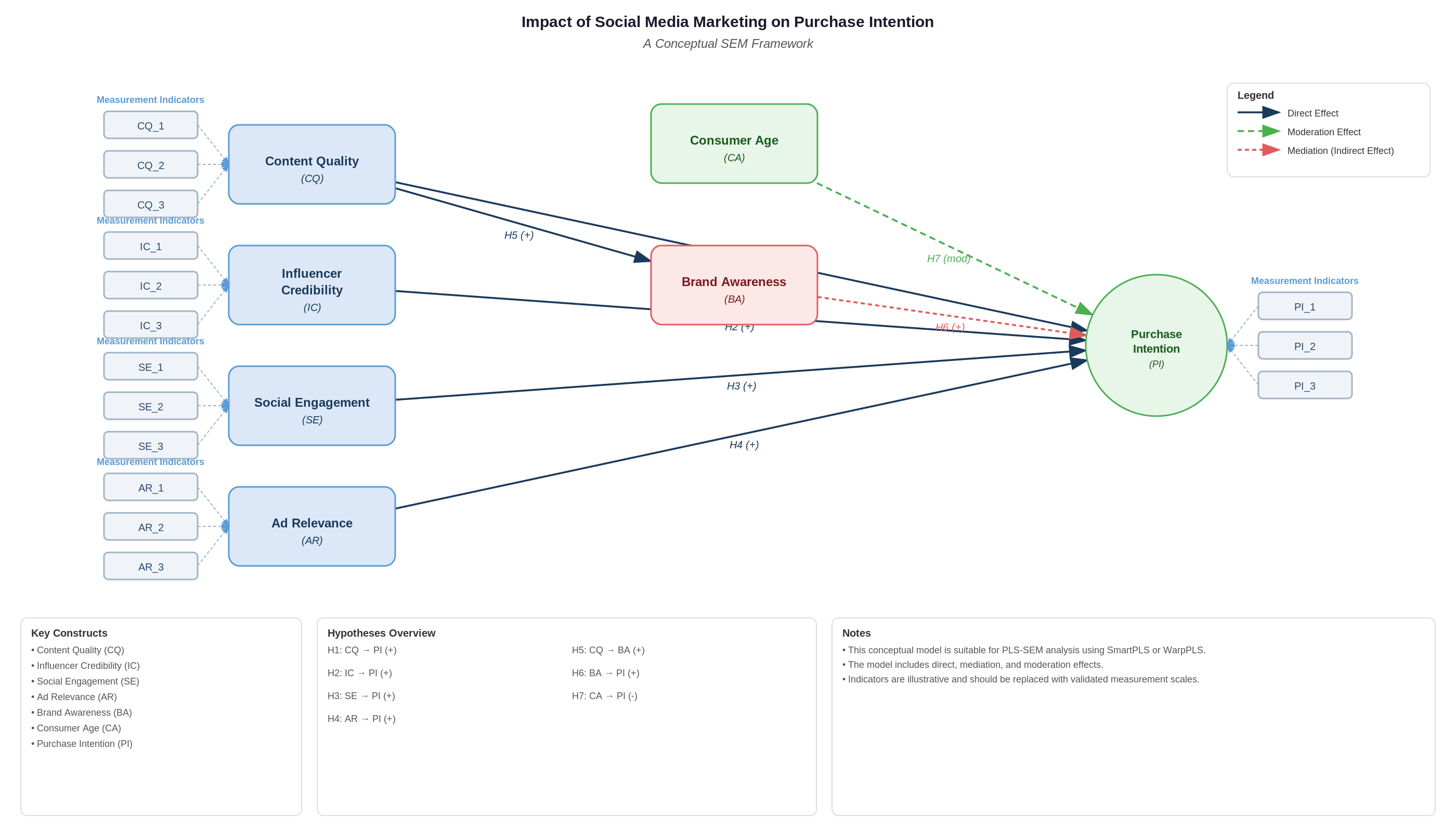
Figure 1: AI-generated SEM conceptual framework for "Impact of Social Media Marketing on Purchase Intention" — generated by FreeAcademicTools.com in under 60 seconds. Topic entered: one sentence.
Generate Your Own Conceptual Framework Now
Enter your research topic → get a publication-ready SEM diagram in under 60 seconds. Free, no sign-up.
Try the Conceptual Model Generator →How to Create a Conceptual Framework for Your Thesis (Step-by-Step)
Whether you use FreeAcademicTools.com or build it manually, every conceptual framework follows the same logical structure. Here is the step-by-step process:
Identify your dependent variable (DV)
Start with the outcome you want to explain. This is the central construct of your study — the thing you are trying to predict or understand. Examples: purchase intention, academic performance, employee turnover, patient satisfaction. Every other variable in your framework exists to explain this one.
List your independent variables (IVs)
These are the predictors — the factors you believe influence the DV. They come from your literature review. For each IV, you need at least one peer-reviewed study that establishes a theoretical basis for the relationship. Aim for 3–6 IVs for a manageable SEM model.
Decide on mediators (if any)
A mediator explains the mechanism: IV → Mediator → DV. Ask yourself: 'Is there a variable that explains how or why IV affects DV?' For example, if training (IV) improves performance (DV), self-efficacy might mediate — training increases self-efficacy, which then improves performance. Mediators are tested with Baron & Kenny's (1986) procedure or bootstrapped indirect effects in PLS-SEM.
Decide on moderators (if any)
A moderator changes the strength or direction of the IV→DV relationship. Ask: 'Does the effect of IV on DV depend on a third variable?' For example, the effect of social media marketing on purchase intention may be stronger for younger consumers (age as moderator). Moderators are tested as interaction terms in SEM.
State each relationship as a hypothesis
Convert each arrow in your diagram into a formal hypothesis with a direction. Example: H1: Content quality has a significant positive effect on purchase intention. Each hypothesis maps to one arrow in the diagram. Hypotheses should be numbered H1, H2, H3… and each should cite at least one prior study that supports the proposed relationship.
Draw or generate the diagram
Place IVs on the left, DV on the right, mediators in the middle, and moderators above or below the main path. Use solid arrows for direct effects, dashed arrows for moderation, and a different colour for mediation paths. Label each arrow with its hypothesis number and direction. FreeAcademicTools.com automates this entire step.
Common Mistake: Confusing Mediators and Moderators
The most common error in student conceptual frameworks is placing a moderator in the mediator position (or vice versa). A mediator is on the causal path (IV → Med → DV). A moderator is not on the path — it changes the strength of an existing path. If you are unsure, read our guide on why AI tools get this wrong and how to verify your model structure.
Conceptual Framework Examples by Research Field
The structure of a conceptual framework varies by discipline and research design. Here are common patterns across major research fields, all of which FreeAcademicTools.com can generate automatically:
Common theory: Technology Acceptance Model (TAM), Resource-Based View
IV: Perceived Usefulness, Perceived Ease of Use → DV: Behavioural Intention to Use → Mediator: Attitude → Moderator: Experience
Common theory: Theory of Planned Behaviour (TPB), S-O-R Framework
IV: Content Quality, Influencer Credibility, Ad Relevance → DV: Purchase Intention → Mediator: Brand Awareness → Moderator: Consumer Age
Common theory: Self-Determination Theory (SDT), Social Cognitive Theory
IV: Teacher Support, Peer Interaction, Learning Resources → DV: Academic Achievement → Mediator: Student Motivation → Moderator: Gender
Common theory: Health Belief Model, Theory of Reasoned Action
IV: Perceived Severity, Perceived Benefits, Cues to Action → DV: Health Behaviour Compliance → Mediator: Self-Efficacy → Moderator: Age
Common theory: UTAUT, DeLone & McLean IS Success Model
IV: System Quality, Information Quality, Service Quality → DV: User Satisfaction → Mediator: Trust → Moderator: Voluntariness
Common theory: Cognitive Behavioural Theory, Attachment Theory
IV: Childhood Adversity, Social Support, Coping Style → DV: Psychological Wellbeing → Mediator: Resilience → Moderator: Personality Type
All of these framework patterns — and hundreds more — can be generated automatically by entering your research topic into FreeAcademicTools.com's Literature Review Generator. The AI identifies the appropriate theoretical foundation, proposes relevant variables, generates hypotheses grounded in the literature, and draws the SEM diagram — all in one workflow.
Also Need a Literature Review with Real References?
FreeAcademicTools.com generates the conceptual model AND the full literature review with verified peer-reviewed citations — in one tool. Unlike ChatGPT, every reference is real and retrievable.
Generate Literature Review + Conceptual Model →Mediator vs Moderator Variables: A Clear Explanation with Diagram Examples
The distinction between mediator and moderator variables is one of the most commonly misunderstood concepts in quantitative research. Getting this wrong in your conceptual framework will result in a structurally incorrect SEM model and an immediate rejection from your thesis committee or journal reviewers.
Mediator Variable
Definition: Explains the mechanism through which IV affects DV. Sits on the causal path.
Diagram position: Between IV and DV, with two arrows: IV→Mediator and Mediator→DV.
Example: Social media marketing (IV) → Brand awareness (Mediator) → Purchase intention (DV)
Test: Bootstrapped indirect effects in PLS-SEM (SmartPLS) or PROCESS macro (SPSS).
Moderator Variable
Definition: Changes the strength or direction of the IV→DV relationship. NOT on the causal path.
Diagram position: Above or below the IV→DV arrow, with a dashed arrow pointing to the path.
Example: Consumer age (Moderator) changes how strongly social media marketing (IV) affects purchase intention (DV).
Test: Interaction term (IV × Moderator) in regression or PLS-SEM.
Quick test: Is your variable a mediator or moderator?
- If the variable is caused by the IV and causes the DV → it is a mediator.
- If the variable changes the strength of the IV→DV relationship but is not caused by the IV → it is a moderator.
- If a variable does both → it is a mediating moderator or moderated mediation — an advanced model type that FreeAcademicTools.com also supports.
What Makes a Publication-Ready SEM Conceptual Model Diagram?
Not all conceptual framework diagrams are equal. Journal reviewers and thesis committees evaluate diagrams against specific quality criteria. Here is what a publication-ready SEM diagram must include — and how FreeAcademicTools.com meets every standard:
How to Use FreeAcademicTools.com to Generate Your Conceptual Framework
The entire process takes under 3 minutes from topic to downloadable PNG. Here is exactly how it works:
Enter your research topic
Go to the Literature Review Generator tool and type your research topic in the topic field. Example: "Impact of remote work on employee productivity and job satisfaction in the IT sector."
Select Quantitative study type
Choose "Quantitative" as the study type. This unlocks the Conceptual Model panel below the literature review output.
Set hypothesis count or enter your own
Use the "How many?" selector to choose 3–10 hypotheses. Or switch to "Enter own" mode to type your own hypotheses if you already have them from your proposal.
Generate hypotheses
Click "Generate Hypotheses". The AI retrieves relevant literature and generates research-grounded hypotheses with direction (positive/negative) and theoretical justification.
Generate the conceptual model
Click "Generate Conceptual Model". The AI identifies the appropriate constructs, assigns roles (IV/mediator/moderator/DV), adds measurement indicators, and renders the SEM diagram.
Download the PNG
Click "Download PNG" to save the high-resolution diagram. Insert it directly into your thesis chapter, research proposal, or journal submission.
Pro tip: Use the custom outline feature
If your supervisor has already given you a specific framework structure or you have a draft outline from your proposal, use the "Use custom outline" toggle in the Literature Review Generator. Paste your own section structure and the AI will follow it exactly — generating the conceptual model consistent with your predefined framework.
Frequently Asked Questions
Is the conceptual framework generator completely free?+
Can I customise the variables in the generated conceptual framework?+
Does the tool support moderated mediation or mediated moderation?+
What citation styles does the literature review use?+
Is the generated conceptual framework plagiarism-free?+
Generate Your Conceptual Framework Now — Free
No sign-up. No credit card. Enter your research topic and get a publication-ready SEM diagram with hypotheses, mediators, moderators, and measurement indicators in under 60 seconds.
Generate Free — No Sign-Up NeededAlso generates a full literature review with 100% real, verified references
References
- [1] Baron, R. M., & Kenny, D. A. (1986). The moderator–mediator variable distinction in social psychological research: Conceptual, strategic, and statistical considerations. Journal of Personality and Social Psychology, 51(6), 1173–1182. https://doi.org/10.1037/0022-3514.51.6.1173
- [2] Hair, J. F., Risher, J. J., Sarstedt, M., & Ringle, C. M. (2019). When to use and how to report the results of PLS-SEM. European Business Review, 31(1), 2–24. https://doi.org/10.1108/EBR-11-2018-0203
- [3] Preacher, K. J., & Hayes, A. F. (2008). Asymptotic and resampling strategies for assessing and comparing indirect effects in multiple mediator models. Behavior Research Methods, 40(3), 879–891. https://doi.org/10.3758/BRM.40.3.879
- [4] Venkatesh, V., Morris, M. G., Davis, G. B., & Davis, F. D. (2003). User acceptance of information technology: Toward a unified view. MIS Quarterly, 27(3), 425–478. https://doi.org/10.2307/30036540
- [5] Creswell, J. W., & Creswell, J. D. (2018). Research Design: Qualitative, Quantitative, and Mixed Methods Approaches (5th ed.). SAGE Publications.
Related Articles
ChatGPT Fake Citations in Literature Reviews: Why AI Hallucinations Are Destroying Student Research (2026)
40% of AI-generated citations are wrong or fabricated. Learn why ChatGPT hallucinates references, why its conceptual models are inaccurate, and how FreeAcademicTools.com solves every pain point.
Best Free AI Literature Review Generators in 2026: Jenni AI vs SciSpace vs Elicit vs Consensus (Tested)
We tested every major AI literature review tool to find out which ones actually write a complete, cited review for free. Honest verdict on Jenni AI, SciSpace, Elicit, and Consensus.