Theoretical Framework Generator
Find established theories that fit your research variables, with author, year, explanation and a framework diagram you can adapt for your thesis.
One shared daily framework allowance
Shares the daily framework allowance with the Conceptual Framework Generator. Free: 1/day; Student: 5/day; Researcher: 15/day; Academic: 9,999/day. Resets at 00:00 UTC. A generation in either tool uses one shared allowance.
1. Enter your research variables
Use a focused topic and variables you can define. You can revise these inputs without losing the suggestions below.
How the Theoretical Framework Maker Works
Enter your study details
Enter your research topic, independent variables (IVs), dependent variable (DV) and discipline. Use clear variable names so the suggestions address what your study actually examines.
Compare established theories
Review 2–3 established theories with their original author, year and an explanation of fit. If fewer than two plausible matches exist, the tool returns a no-match message instead of inventing a theory.
View your starting diagram
Use the theoretical framework diagram maker to view each theoretical lens alongside your variables. Diagram downloads are available on eligible paid plans; adapt the layout to your research design.
Theories This Generator Can Suggest
Suggestions come from this fixed catalogue, spanning technology adoption, motivation, organizational strategy and media use.
| Theory | Original author(s) and year | Typical research use |
|---|---|---|
| Technology Acceptance Model | Fred D. Davis (1986)Original MIT dissertation | Examines how usefulness and ease-of-use beliefs relate to acceptance of a technology in a specific setting. |
| Theory of Planned Behaviour | Icek Ajzen (1985)Original chapter | Explains intentions toward a specified behaviour through attitudes, subjective norms and perceived behavioural control. |
| Self-Determination Theory | Edward L. Deci and Richard M. Ryan (1985) | Examines how autonomy, competence and, in later developments, relatedness support motivation, engagement and persistence. |
| Social Cognitive Theory | Albert Bandura (1986) | Studies learning and behavioural regulation through self-efficacy, observation and reciprocal personal, behavioural and environmental influences. |
| Diffusion of Innovations | Everett M. Rogers (1962) | Explores how innovation attributes, communication channels and social systems shape adoption and spread over time. |
| Maslow’s Hierarchy of Needs | Abraham H. Maslow (1943) | Uses needs as a flexible lens for motivational priorities without assuming a rigid universal sequence. |
| Herzberg’s Two-Factor Theory | Frederick Herzberg, Bernard Mausner and Barbara Bloch Snyderman (1959) | Distinguishes workplace satisfaction associated with intrinsic motivators from dissatisfaction associated with job-context hygiene factors. |
| Resource-Based View | Birger Wernerfelt (1984) | Examines how internal resources and resource-position barriers can contribute to firm strategy and competitive advantage. |
| Stakeholder Theory | R. Edward Freeman (1984) | Analyses organizational decisions through stakeholder interests, relationships, responsibilities and the creation of value. |
| Uses and Gratifications | Elihu Katz, Jay G. Blumler and Michael Gurevitch (1973) | Investigates why audiences choose particular media through their motives and gratifications sought or obtained. |
Davis’s 1989 TAM measurement-validation paper in MIS Quarterly and Ajzen’s 1991 TPB review are later publications, not the original formulations listed above.
Theoretical Framework Example
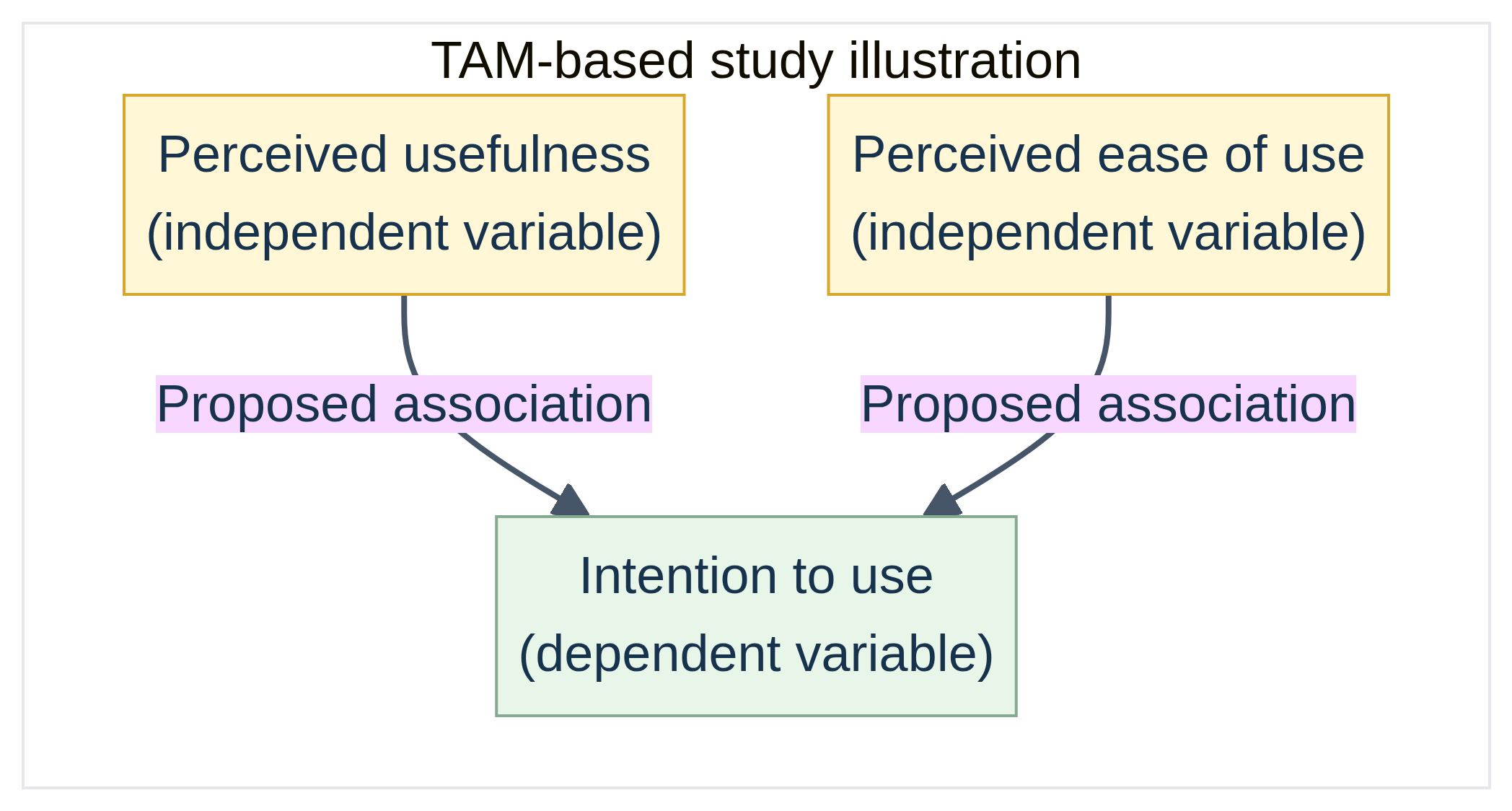
- Topic:
- Students' intention to use an online learning platform
- IVs:
- Perceived usefulness and Perceived ease of use
- DV:
- Intention to use
- Theory:
- Technology Acceptance Model (TAM)
TAM provides a lens for relating students’ beliefs about a platform’s utility and usability to their intention to use it. Perceived usefulness concerns support for learning tasks, while perceived ease of use concerns the effort students expect. The illustrative paths connect these beliefs with intention, not guaranteed adoption or improved learning outcomes. Define and measure each construct for your setting, using Davis’s original formulation to justify the adaptation.
Theoretical vs Conceptual Framework
A theoretical framework draws on an established theory to explain why relationships between your variables make sense. A conceptual framework organizes your study’s specific variables and proposed relationships, and may draw on more than one theoretical lens.
Frequently Asked Questions
What is a theoretical framework generator?
A tool that suggests established theories that fit your research variables, with the original author, year, a short explanation and a simple diagram you can adapt.
Is the theoretical framework generator free?
Yes, with a free account you get one framework generation per day, shared with the Conceptual Framework Generator. Paid plans include more generations and diagram downloads.
Can AI make a theoretical framework for my thesis?
It can suggest suitable theories and a starting diagram, but you still need to read the original sources and explain why the theory fits your study.
Which theory should I use for my research?
The one that explains the relationship between your variables. Compare the suggestions, read the original works, and confirm with your supervisor.
Does it give real citations?
It only suggests well-known theories from a fixed list, with the original author and year. Always check the original source before citing.
What is the difference between a theoretical and a conceptual framework?
A theoretical framework uses an existing theory; a conceptual framework maps your own study's variables and how you expect them to relate.
Related Tools
Conceptual Framework Generator
Map your study variables and proposed relationships into a conceptual diagram.
RRL Generator
Develop a literature-review starting point to organize the research surrounding your topic.
Citation Generator
Format references using the source details you provide for your academic writing.