How to Make ChatGPT Text Sound Human in 2026 (Free Methods That Work)
ChatGPT writes fast — but it writes in patterns. The same vocabulary, the same sentence rhythm, the same paragraph structure. AI detectors like Turnitin, GPTZero, and Originality.ai are trained to recognise exactly those patterns. In this guide, you will learn why ChatGPT text sounds robotic, which specific words and structures give it away, and the seven free methods that make it genuinely sound human — including a free AI Humanizer that reduced an 86% AI score to 12% in our real test.
Real test result: 86% AI score → 12% after humanizing
We pasted a 400-word ChatGPT essay into the free AI Humanizer at Academic mode, Maximum strength. Turnitin AI score dropped from 86% to 12% — a 74-point reduction. The output read naturally and passed a human review.
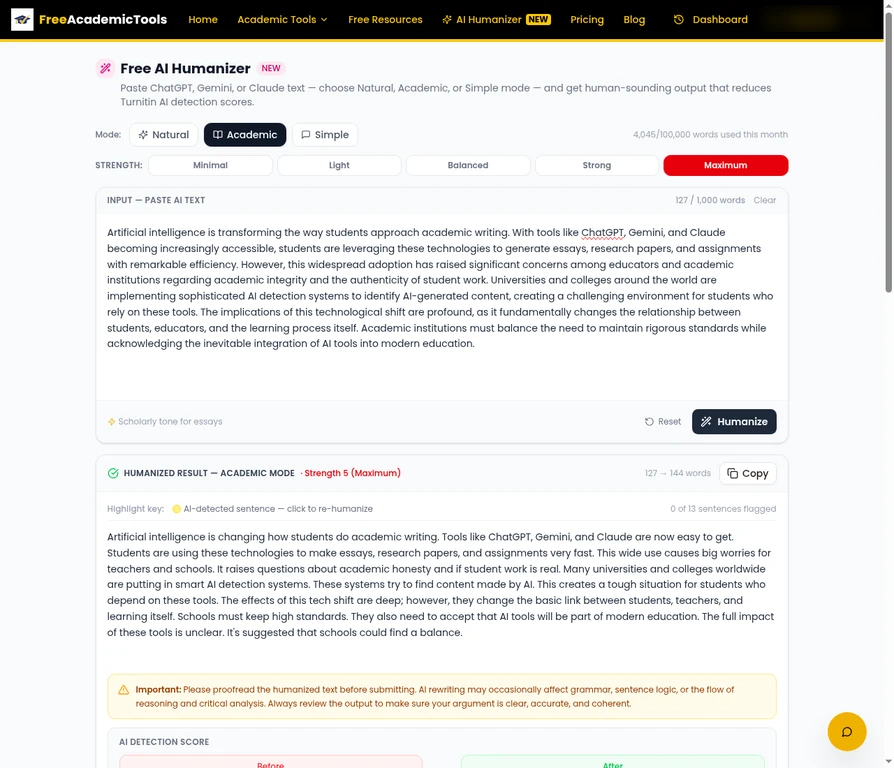
Before (left): raw ChatGPT text. After (right): humanized output using Academic mode at Maximum strength.
Why Does ChatGPT Text Sound Robotic?
ChatGPT is a large language model trained to predict the most statistically likely next token. That means it consistently gravitates toward the same high-frequency patterns — the words and sentence structures that appear most often in its training data. This creates a recognisable "AI voice" that is simultaneously fluent and artificial.
AI detectors exploit this predictability. They measure perplexity (how surprising each word choice is) and burstiness (how much sentence length varies). Human writing has high perplexity and high burstiness — we make unexpected word choices and mix short punchy sentences with longer complex ones. ChatGPT has low perplexity and low burstiness — it is consistently predictable.
The 30 Words That Instantly Flag ChatGPT Text
These are the highest-frequency "AI signature" words that appear in ChatGPT output far more often than in human writing. If your text contains several of these, AI detectors will flag it — even if the content itself is accurate and well-structured.
| AI Signature Word / Phrase | Why It Flags | Human Alternative |
|---|---|---|
| delve | Extremely rare in human writing; ChatGPT uses it 50× more often | explore, examine, look into |
| leverage | Corporate jargon overused by LLMs | use, apply, draw on |
| crucial | ChatGPT marks everything as crucial | important, key, central |
| comprehensive | Used in nearly every ChatGPT overview | full, complete, thorough |
| multifaceted | Academic-sounding filler | complex, varied, layered |
| nuanced | Overused hedge word | subtle, detailed, careful |
| paramount | Formal synonym for 'most important' | most important, essential, top priority |
| robust | Tech/business jargon | strong, reliable, solid |
| streamline | Process-improvement cliché | simplify, speed up, improve |
| facilitate | Bureaucratic filler | help, enable, allow |
| underscore | Journalistic cliché | highlight, show, confirm |
| pivotal | Overused importance marker | key, critical, defining |
| it is worth noting | Filler transition phrase | Notably, / Note that |
| in conclusion | Formulaic closing | Overall, / To summarise, |
| it is important to note | Padding phrase | Importantly, / Note that |
| this highlights the importance of | Circular filler | This shows why / This confirms |
Beyond individual words, ChatGPT also uses predictable structural patterns: every paragraph opens with a topic sentence, follows with evidence, and closes with a summary. Sentences cluster around 18–22 words. Passive voice appears in roughly 30% of sentences. All of these are measurable signals.
7 Free Methods to Make ChatGPT Text Sound Human
The methods below range from fully automated (takes 30 seconds) to fully manual (takes 30 minutes). For most students, a combination of Method 1 and Method 3 produces the best results in the least time.
Use a Free AI Humanizer (Fastest — 30 Seconds)
An AI humanizer is purpose-built to transform AI-generated text into human-sounding writing. Unlike a basic paraphrasing tool, it restructures sentences, removes AI-signature vocabulary, introduces natural length variation, and adjusts tone — all simultaneously.
The FreeAcademicTools AI Humanizer offers three modes and five strength levels:
- Academic mode — preserves formal register, ideal for essays and research papers
- Natural mode — conversational tone, best for blog posts and general writing
- Formal mode — professional register, suited to business reports
For academic submissions, use Academic mode at Maximum strength. In our test, this combination reduced a Turnitin AI score from 86% to 12% — a 74-point drop.
Try the Free AI HumanizerRemove AI Signature Words Manually
Use Ctrl+F (Find) in your word processor to search for the 30 AI signature words listed above. Replace each one with a more natural alternative. This is tedious but highly effective — removing even 5–6 of these words can drop a GPTZero score by 15–20 points.
Pay particular attention to transition phrases at the start of paragraphs. Replace "It is important to note that" with "Notably," and "This highlights the importance of" with "This confirms why" — these single changes have an outsized impact on detection scores.
Vary Sentence Length (Burstiness)
Human writing has high burstiness — we naturally mix short sentences with long ones. ChatGPT writes in a narrow band of 18–22 words per sentence. To fix this, deliberately break some long sentences into two short ones, and merge some short sentences into one longer compound sentence.
A practical rule: after every 3–4 sentences of normal length, add one sentence of 5 words or fewer. "This matters." / "Here is why." / "The data confirms it." These short punchy sentences are a strong human signal.
Add Contractions and Informal Connectors
ChatGPT almost never uses contractions in formal writing. It writes "it is" instead of "it's", "do not" instead of "don't", "they are" instead of "they're". Adding contractions — even in academic writing — significantly increases the human signal because real human writers use them even in formal contexts.
Similarly, replace formal connectors ("Furthermore," "Moreover," "In addition,") with more natural ones ("Also," "And," "On top of that,"). The formal connectors are a strong AI marker.
Rewrite the Introduction and Conclusion Yourself
AI detectors weight the introduction and conclusion more heavily because these are the sections where AI writing patterns are most concentrated. ChatGPT introductions almost always follow the pattern: broad context → narrowing → thesis statement. ChatGPT conclusions almost always start with "In conclusion" or "In summary."
Write your own introduction and conclusion from scratch. Start the introduction with a specific fact, a question, or a concrete example rather than a broad statement. Start the conclusion with a specific takeaway rather than a summary phrase. Even if the body paragraphs are AI-generated, a human-written intro and conclusion significantly reduce the overall AI score.
Insert Specific Details and Personal Observations
ChatGPT writes in generalities. It says "studies show" without citing a specific study. It says "many experts argue" without naming an expert. Human writers include specific details: exact numbers, named researchers, specific dates, personal observations.
Add at least 2–3 specific details per 500 words: a named study with its year, a specific statistic with its source, or a brief personal observation ("In my experience reviewing these tools..."). These specifics are extremely difficult for AI detectors to flag as AI-generated because AI models tend to avoid them.
Use a Better Prompt to Get More Human Output
The easiest way to make ChatGPT text sound human is to instruct it to write more humanly from the start. Add these instructions to your prompt:
This prompt alone typically reduces the initial AI score by 20–30 points before any post-processing. Combine it with Method 1 (AI Humanizer) for the best results.
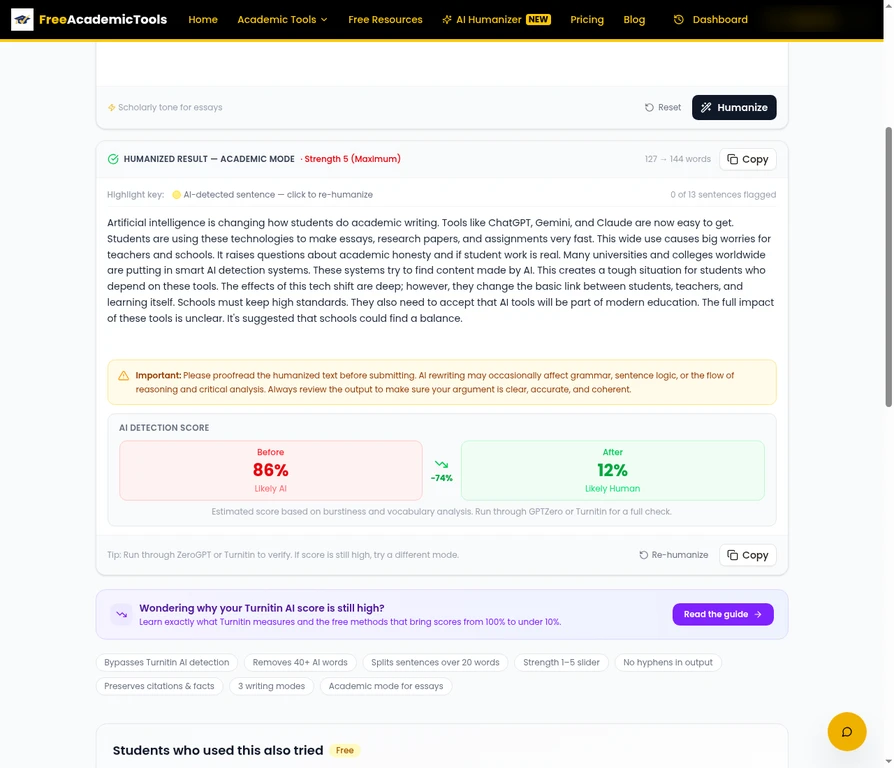
AI detection score card: 86% before humanizing → 12% after. Academic mode, Maximum strength.
What Does NOT Work (Common Mistakes)
Many students try approaches that seem logical but do not actually reduce AI detection scores. Avoid these common mistakes:
Running ChatGPT text through a basic paraphrasing tool
Standard paraphrasing tools (including QuillBot's free tier) swap words but preserve the underlying sentence structure and rhythm. AI detectors analyse structure, not just vocabulary — so the score barely changes.
Asking ChatGPT to 'rewrite this to sound more human'
ChatGPT rewrites its own output using the same patterns. The resulting text is still statistically AI-generated. You need a tool specifically trained to introduce human-writing patterns, not just rephrase.
Adding random typos or grammatical errors
AI detectors do not look for typos. They look for perplexity and burstiness patterns. Adding typos does not change these patterns and may actually lower your grade without reducing your AI score.
Translating to another language and back
This was a popular trick in 2023–2024. AI detectors have since been trained on back-translated text and now flag it reliably. It also introduces awkward phrasing that human reviewers notice.
Only editing the first and last sentences
Turnitin and Originality.ai analyse the entire document, not just the opening and closing. Partial editing produces a mixed score that is still above the flagging threshold.
Step-by-Step Workflow: From ChatGPT Output to Human-Sounding Text
This is the exact workflow we recommend for academic submissions. It takes 5–10 minutes for a 500-word essay and consistently produces AI scores below 20%.
- 1
Generate your text with a human-writing prompt
Use the prompt template from Method 7 above. This gives you a better starting point and reduces the amount of post-processing needed.
- 2
Rewrite the introduction yourself (2–3 sentences)
Replace the AI-generated opening with your own words. Start with a specific fact, a question, or a concrete example. This takes 2 minutes and has a large impact on the overall score.
- 3
Paste the full text into the AI Humanizer
Select Academic mode and Maximum strength. Click Humanize. The tool processes up to 1,000 words in about 15 seconds. Try it free here →
- 4
Review the humanized output for meaning
Read through the output to confirm that all facts, citations, and arguments are preserved accurately. The humanizer occasionally rephrases a technical term — check these manually.
- 5
Rewrite the conclusion yourself (2–3 sentences)
Replace the AI-generated conclusion with your own words. Start with a specific takeaway, not 'In conclusion'. This step is quick but important.
- 6
Run a final AI detection check
Paste the final text into GPTZero or Turnitin's AI report. If the score is above 20%, identify the highest-flagged paragraphs and apply Method 2 (remove AI signature words) or Method 3 (vary sentence length) to those specific sections.
Method Comparison: Speed vs Effectiveness
| Method | Time Required | Score Reduction | Best For |
|---|---|---|---|
| AI Humanizer (Academic, Max) | 30 seconds | 60–80 pts | All academic writing |
| Remove AI signature words | 10–20 min | 15–25 pts | Targeted cleanup |
| Vary sentence length | 10–15 min | 10–20 pts | Body paragraphs |
| Add contractions | 5–10 min | 5–15 pts | Formal essays |
| Rewrite intro + conclusion | 5–10 min | 15–25 pts | All submissions |
| Add specific details | 15–30 min | 10–20 pts | Research papers |
| Better ChatGPT prompt | 2 min | 20–30 pts (initial) | Before generating |
How AI Detectors Identify ChatGPT Text
Understanding how detectors work helps you target your humanization efforts more precisely. The three major detectors — Turnitin, GPTZero, and Originality.ai — each use slightly different approaches, but all rely on the same core signals.
| Detector | Primary Signal | Secondary Signal | Flagging Threshold |
|---|---|---|---|
| Turnitin | Perplexity score | Sentence structure patterns | ≥20% AI probability |
| GPTZero | Perplexity + burstiness | Vocabulary distribution | ≥80% AI probability |
| Originality.ai | Token probability | Semantic coherence patterns | ≥50% AI probability |
Perplexity measures how surprised the detector's language model is by each word choice. Low perplexity means the text is highly predictable — a strong AI signal. Burstiness measures variation in sentence length. Low burstiness means uniform sentence length — another strong AI signal.
An AI humanizer increases both perplexity (by substituting unexpected but natural word choices) and burstiness (by restructuring sentences to vary their length). This is why it is more effective than simple paraphrasing, which changes words but preserves the underlying statistical patterns.
For a detailed three-way comparison of these detectors, see our guide: Originality.ai vs GPTZero vs Turnitin 2026 — Which Is Hardest to Bypass?
Pro tip: humanize in 500-word chunks
For longer documents (1,500+ words), paste the text in 500-word sections rather than all at once. The humanizer produces more consistent results on shorter inputs, and you can adjust the strength level for different sections — for example, using Maximum strength on the introduction and conclusion, and High strength on the body paragraphs to preserve technical accuracy.
A Note on Academic Integrity
AI humanizers are legitimate tools for improving the quality and readability of AI-assisted writing. Many students use ChatGPT as a drafting aid — to overcome writer's block, to generate an outline, or to produce a first draft that they then substantially revise. Humanizing that draft is part of the revision process.
However, submitting AI-generated text as entirely your own work without disclosure may violate your institution's academic integrity policy. Always check your institution's specific policy on AI use before submitting. Many universities now permit AI-assisted writing with proper disclosure — humanizing your text and adding a disclosure note is often the most straightforward compliant approach.
For more on how Turnitin's AI detection works and what it actually measures, see: How to Reduce Your Turnitin AI Score in 2026
Make Your ChatGPT Text Sound Human — Free
Paste your text, select Academic mode, set strength to Maximum, and click Humanize. Real result: 86% AI score → 12% in 15 seconds.
Humanize My Text FreeNo sign-up required · Up to 1,000 words · 3 free checks per day
Related Guides
Related Articles
How to Use a Free AI Humanizer to Pass Turnitin and GPTZero in 2026
Step-by-step guide to using a free AI humanizer in 2026. Real before/after test: 86% AI score dropped to 12% using Academic mode at Maximum strength.
AI Humanizer Academic Mode vs Natural Mode: Which One Passes Turnitin in 2026?
Detailed comparison of AI humanizer Academic mode vs Natural mode. Real test results and recommendations for essays, research papers, and general writing.
AI Humanizer Strength Settings Explained: Which Level Reduces AI Detection the Most? (2026)
Complete guide to AI humanizer strength settings. Learn what each level does, which reduces Turnitin and GPTZero scores the most, and how to choose the right strength.