Research workflow guide · Updated 4 October 2026
How to Organize Literature Review Sources: A Source Screening Workflow
A clear literature review starts before the first paragraph. Use a source-first workflow to keep the records you choose, evaluate the original research, record your reasoning, and compare evidence before drafting.
Quick answer
Organize literature review sources by moving from source leads to evaluated records, screening notes, and then a thematic comparison. Keep the author, year, DOI, method, relevant finding, context, and limitation close to the original source. Only then use the included records to plan a synthesis or outline.
A Four-Step Literature Review Source Workflow
- Find source leads by topic, title, DOI, or author.
- Open and evaluate the original work for relevance, method, evidence, context, and limitations.
- Save only selected source records, then mark them as candidate, screening, included, or excluded and add a researcher note.
- Compare included sources by theme, method, setting, finding, or limitation before writing a synthesis.
Evidence Review Workspace Walkthrough
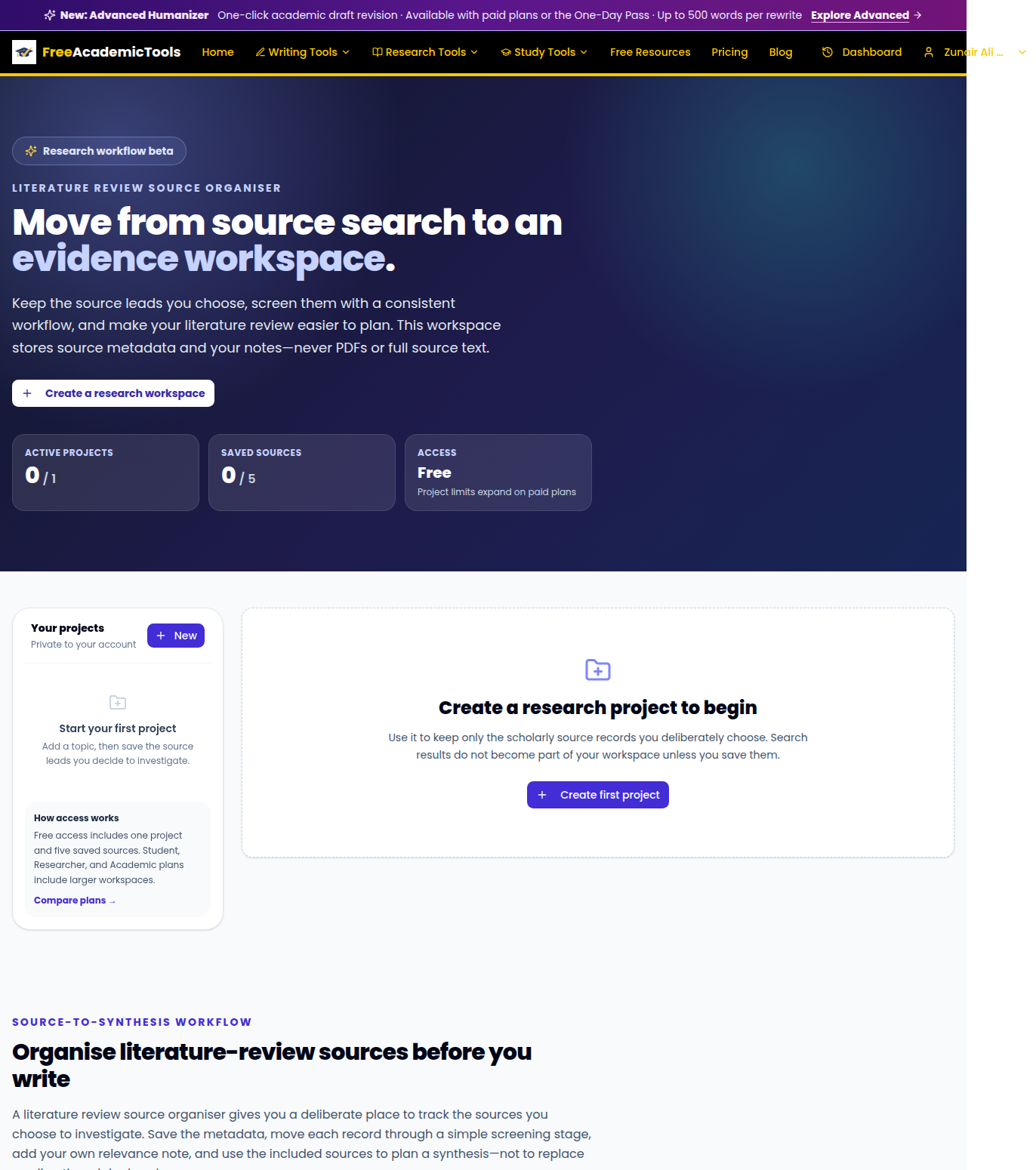
The Evidence Review Workspace supports private projects, deliberately saved scholarly source metadata, screening status, relevance ratings, and researcher notes. Searches are not automatically saved. The workspace does not store PDFs or full source text.
From Records to a Synthesis Matrix
A source organizer tracks individual records and screening decisions. A synthesis matrix compares included records by shared themes or variables. Johns Hopkins Sheridan Libraries notes that a synthesis matrix records source main points and shows relationships across themes or variables. Read the guidance.
What This Workspace Does Not Do
It does not decide whether a paper is credible, assess research quality automatically, store PDFs, conduct blinded multi-reviewer screening, create PRISMA records, or validate conclusions. It is not systematic-review software. The researcher remains responsible for original-source evaluation and method requirements.
Frequently Asked Questions
Is a literature review source organizer the same as a synthesis matrix?
No. A source organizer helps track selected records and screening notes. A synthesis matrix compares included sources by shared themes or variables before writing.
Can a source organizer tell me whether a paper is credible?
No. Researchers must read the original work and assess authorship, method, evidence, relevance, limitations, and fit with the research question.
Sources for this guide
About the Author
Zunair Ali Syed is a doctoral researcher in Management Sciences at Minhaj University Lahore and a research consultant with experience in academic research and editing since 2011. He runs QuickEduHelp, with professional interests in digital learning, research methods, and evidence-based academic support.