How Inventions Changed Everyday Life: A Reader’s Guide
A new invention does not become an everyday habit merely because it works. Equipment, shared rules, distribution, public understanding and repeated use can all shape what happens next. Looking at those arrangements makes the history of everyday objects more interesting than a list of inventors and dates.
By Zunair Ali Syed · Published 3 November 2026
Author disclosure: Zunair Ali Syed, who runs FreeAcademicTools, wrote the featured book and receives royalties from its sales. This is an author-owned book introduction, not an independent review or a number-one ranking.
How did inventions change everyday life?
Inventions changed everyday life when people could use them repeatedly within workable systems. A device, code or agreement might be an important beginning, but familiar routines also depend on supporting equipment, coordination and people learning a new practice. The three historical examples below show why a launch date is not the same thing as widespread adoption.
This guide is for curious adult readers and students exploring history beyond a syllabus. It introduces one author-owned book and offers independently sourced reading examples. It is not a comparative ranking, a textbook recommendation or an assignment answer.
Featured reading: When Everyday Life Changed
When Everyday Life Changed: 12 Stories of How Inventions Became Everyday Habits, by Zunair Ali Syed, follows twelve stories about how familiar practices took hold. According to its published description, the emphasis is on the arrangements surrounding adoption: rules, standards, supporting equipment, training, trust and choices people made. [1]
The description spans postage, elevator safety, standard time and traffic signals, then household and commercial technologies such as dishwashers, cameras, fasteners, frozen food, shopping carts and shipping containers. ZIP Codes and barcodes also appear in the advertised scope. These topics make the book a possible starting point for adults interested in the hidden history of familiar routines; check the available sample and contents before deciding whether it fits your interests. [1]
The public paperback listing identifies an English, 96-page edition published on 30 October 2026, ISBN 979-8166455048. A Kindle edition is also listed. Format, availability and current price are determined by Amazon in your marketplace. [1]
View the paperback on Amazon View the Kindle edition
The overview above is based on the published listing, not a first-hand manuscript assessment. The examples that follow were researched independently from the linked sources; they are not quotations, chapter summaries or excerpts from the book.
An invention date and an adoption story answer different questions
When reading about an everyday invention, ask what the reported date actually marks. Is it a patent, a public demonstration, a first installation, an organisational decision or a change in the law? Those events can matter for different reasons. Treating them as interchangeable can turn a complicated history into a misleading origin story.
In this guide, adoption means people or organisations taking up a practice. It does not mean that every household or country used it at the same time. The examples below concern particular U.S. developments; they are not a single worldwide timeline. The distinction becomes especially clear when a familiar practice depends on institutions as well as equipment.
ZIP Codes: introducing a system still required public learning
The U.S. Post Office Department introduced the five-digit ZIP Code on 1 July 1963. USPS’s historical account describes Mr. ZIP appearing in public-service announcements and advertisements that encouraged postal customers to use the codes. The campaign made the new addressing practice visible to the people expected to adopt it. [2]
This is more than a story about adding digits to an envelope. An addressing system had to connect administrative arrangements with everyday behaviour. Customers needed to recognise the change and know what to do. The launch tells us when the system began, while the publicity helps explain how people encountered it.
Reading question: What work happened outside the code itself to encourage its use? Keep awareness separate from behaviour: recognising a mascot does not prove that every person correctly used a ZIP Code. Nor does the U.S. launch establish when postal coding began elsewhere.
Standard time: coordination came before federal recognition
NIST’s historical account dates implementation of the U.S. railroad industry’s Standard Railway Time System to 18 November 1883. It describes most cities adopting railway time while controversy continued. The U.S. Naval Observatory distinguishes that development from federal recognition through the Act of 19 March 1918, commonly called the Standard Time Act. [3] [4]
These are two milestones, not competing answers to one simple question. Railroad coordination concerns a working scheduling arrangement; the later law concerns national legal recognition. Neither date is the invention of clocks or timekeeping. Keeping the milestones separate reveals how a shared convention spread through institutions and daily practice.
Reading question: Who had to coordinate, and which decision changed their obligations? A schedule is useful only when the people relying on it understand the time convention. That is why this history includes agreements and public use, not only the mechanism of a clock.
Retail barcodes: a memorable first scan was not universal adoption
GS1 US records a retail UPC checkout milestone on 26 June 1974: a ten-pack of Wrigley’s chewing gum was scanned at a Marsh Supermarket in Troy, Ohio. Describe this specifically as a retail UPC scan, not the invention of every type of barcode. [5]
The subsequent timeline matters too. GS1 records the establishment of the European Article Numbering Association in 1977 with a barcode compatible with the U.S. UPC. Its timeline describes expansion beyond checkout to wholesale multipacks, cases and cartons in 1983. These developments show extension of a shared system, not a date on which every shop adopted it. [6]
Reading question: What needed to be compatible for the practice to travel? The visible label is only part of the story. Readers can investigate the connections between product identification, equipment and participating organisations rather than assuming that a successful demonstration made all later use inevitable.
A simple way to read the history of everyday objects
The examples suggest a useful reading lens: look at the initial possibility, the supporting arrangements, the people who changed their practices and the routine that resulted. This is an original teaching aid, not a universal model of historical progress. The order can overlap, practices can fail to spread and later changes can reshape earlier arrangements.
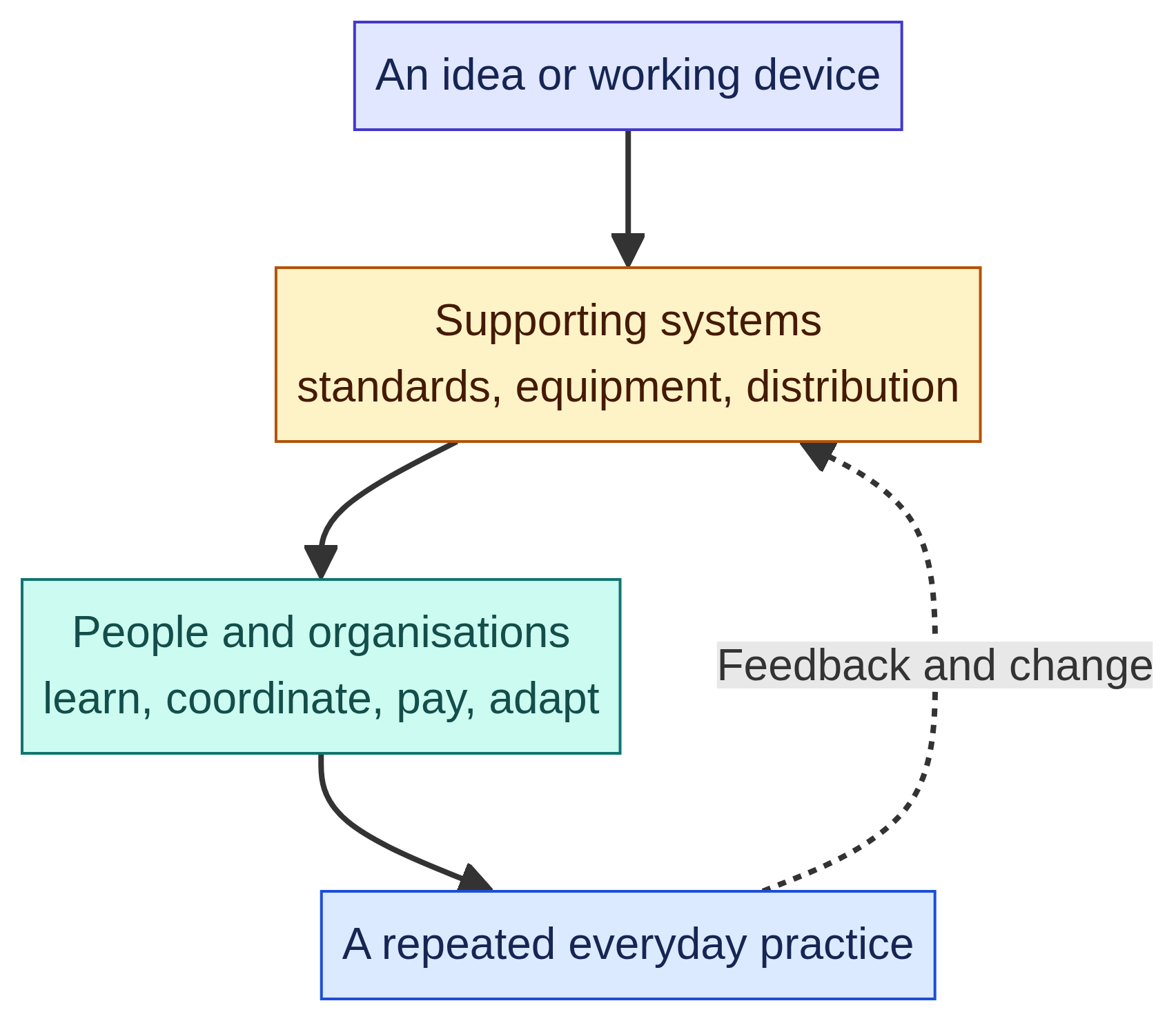
Choose one familiar practice and ask: what made it possible, what made it usable and what encouraged people to repeat it? Then look for evidence that separates those explanations. A manufacturer’s announcement can show a product launch; an institutional record can show implementation; evidence of wider use answers another question. One source does not necessarily establish all three.
If you are comparing accounts, keep a short note of the event, date, location, source and what that source supports. Record unanswered questions too. This helps you distinguish a checked milestone from your interpretation of why a routine spread.
Choosing a book about everyday inventions
Start with the reading job you want the book to do. A technical explanation of how a device works is different from a history of its social effects. A broad history textbook covers a different scope from a short collection about everyday routines. Check the contents, available sample, references and intended audience rather than relying on a title alone.
For When Everyday Life Changed, the published description points toward adult nonfiction about adoption and supporting arrangements. It does not establish a particular school reading level or curriculum approval. A student considering it for coursework should check the instructor’s requirements and evaluate the text itself. A popular-history narrative can open a question without serving as the only evidence for an academic claim.
For optional further research, the Academic Source Finder can help discover scholarly records. Finding a record does not confirm historical accuracy or that the source supports your claim: read and evaluate the original material. The Citation Generator can help format supplied reference details, but it does not validate the event, quotation or interpretation you are citing.
Take notes in your own words, keep page references for quotations and distinguish the author’s account from your own interpretation. These questions are prompts for reading, not paragraphs to submit as an assignment. Follow your course’s citation and academic-integrity requirements when using any book or this guide.
If the advertised scope matches your interests, check the book’s listing and available sample on Amazon. The author receives royalties from purchases. A purchase is optional; the source-backed examples and reading questions on this page are available without buying the book.
Reader questions
What is When Everyday Life Changed about?
According to its published description, it follows twelve stories about how familiar practices were adopted, including postage, standard time, traffic signals and other household or commercial technologies. Its emphasis is on supporting arrangements and repeated choices, not only invention dates.
Is this a list of the best history books for students?
No. This is a source-led reading guide with one disclosed author-owned book introduction. It does not independently rank books or establish textbook suitability.
Can students use the book for coursework?
Check the actual text, available sample and course requirements first. The listing positions it for adult nonfiction readers, not an approved curriculum. Any factual claim used in coursework needs relevant evidence and accurate citation.
Did the three practices become universal on their launch dates?
No. The dates identify particular U.S. launch, implementation or retail milestones. They do not show that every country, organisation or household adopted the practice at once.
Are the historical examples excerpts from the book?
No. They were researched independently from USPS, NIST, the U.S. Naval Observatory and GS1 sources. The book overview is based on the public listing, not a first-hand manuscript review.
Does FreeAcademicTools receive money from book purchases?
The featured book was written by Zunair Ali Syed, who runs FreeAcademicTools and receives author royalties from sales. That relationship is disclosed near the feature and purchase links.
Sources and further reading
Sources checked on 3 November 2026. The retailer supports book metadata and advertised scope; the official historical sources support the particular milestones above. NIST’s page is a historical archive, identified as accurate as of 2004, rather than a current time-service instruction. This guide is independent and is not affiliated with or endorsed by USPS, NIST, the U.S. Naval Observatory, GS1 or Amazon.